The Evolution of Audio Guides in Museums: From Devices to Apps
Twenty years ago, visiting a major museum meant stopping at a rental desk to pick up a handheld audio guide device. You’d navigate through exhibits using a numbered system, listening to prerecorded commentary through headphones. The experience was personal, but controlled—museums determined the narrative path and content delivery.
Today, visitors unlock personalized audio guide experiences by scanning a QR code with their smartphone. Artificial intelligence learns visitor interests and adapts content in real time. Museums track which exhibits command attention, which narratives resonate most, and which visitor paths dominate. This transformation didn’t happen overnight. It reflects two decades of technological evolution, changing visitor expectations, and museums learning to embrace digital-first strategies.
The shift from rental devices to mobile apps is more than a technology upgrade. It represents a fundamental change in how museums serve visitors, manage operations, and think about cultural accessibility. Understanding this evolution matters because museums worldwide are still navigating it—deciding whether to build native guide apps, adopt web-based solutions, or implement AI-powered personalization systems.
This is the story of how audio guides evolved over the past two decades—and what it reveals about the future of cultural experiences.

2005-2010: The Multimedia Device Era
In the mid-2000s, audio guides were about to undergo their most dramatic upgrade since cassettes became standard. Museums began deploying dedicated multimedia devices with touchscreens—pocket-sized tablets filled with audio, video, images, and interactive maps. Visitors could still rent them at admission, but now they offered rich, multimedia experiences far beyond audio alone.
The British Museum, Louvre, and Metropolitan Museum of Art invested heavily in these systems. The technology was genuinely impressive: high-resolution artifact images, contextual videos, multiple language options, and interactive maps. For major institutions with substantial budgets, these devices became symbols of technological sophistication and visitor service commitment.
But operational challenges remained significant. Museums needed to purchase, maintain, and distribute thousands of devices. Hardware depreciated rapidly. Sanitation became increasingly important. Charging infrastructure consumed staff resources. Smaller museums simply couldn’t justify the investment—creating a digital divide where only wealthy institutions could offer sophisticated audio guide experiences.
Meanwhile, something else was happening in visitors’ pockets. In 2007, the iPhone launched. Nobody yet understood that this consumer device would transform museums more fundamentally than any purpose-built technology ever could.
2010-2015: Smartphones Disrupt the Museum Technology Model
As smartphones became ubiquitous in the early 2010s, forward-thinking museums faced a fundamental choice: continue investing in expensive rental device ecosystems, or embrace a completely different delivery model. The real revolution was the shift to smartphone-based applications.
Museums discovered something profound: they no longer needed to provide hardware. Visitors arrived with powerful computers in their pockets. The museum’s role became creating compelling content and experiences that visitors could access through devices they already owned and felt comfortable using. This simple shift solved multiple problems simultaneously. No capital investment in devices. No sanitation concerns. No inventory management. No planned obsolescence headaches. No staff dedicated to device distribution and collection.
Early museum apps were often rudimentary—basic exhibit lists with audio files attached. But the model was revolutionary in implications. Visitors could download before arrival, explore at their own pace, and skip content that didn’t interest them. GPS technology meant location awareness: the app could trigger audio automatically as visitors approached specific galleries. Bluetooth connectivity enabled indoor location-based services where GPS failed. QR codes created bridges between physical exhibits and digital content, allowing museums to connect printed materials to rich multimedia experiences.
By 2015, the trajectory was unmistakable. Museums weren’t abandoning rental devices overnight, but new institutions were launching smartphone-first strategies. The question wasn’t whether mobile would become the primary platform, but how quickly the transition would complete. Those five years of experimentation created technical foundations and business models that would define the next era.
The transition accelerated because something unexpected was about to reveal exactly how critical device independence would become.
2015-2020: Mobile-First Becomes Mandatory
By the late 2010s, major museums had largely completed the transition to mobile-first strategies. Smaller museums and cultural institutions discovered that Progressive Web Applications (PWAs)—sophisticated web apps accessed via QR codes rather than app store downloads—could deliver professional experiences without friction.
This era revealed another critical insight: abandoning rental devices actually increased the importance of content quality. When visitors used their own devices, museums couldn’t control engagement through interface design or limited options. Content had to be compelling enough that visitors chose to engage rather than simply scrolling past.
Then, in March 2020, the pandemic shut museums worldwide. Rental device systems became instantly obsolete. Shared physical equipment felt dangerous. The museums that had invested in mobile-first strategies survived the crisis dramatically better positioned than those still relying on device rentals. Some institutions dependent on rental systems never fully recovered their previous visitation levels.
As museums reopened in late 2020 and 2021, visitors had developed new expectations shaped by the pandemic. Mobile-based experiences felt safer than shared devices. The pandemic accelerated the device-to-app transition by approximately five years. By 2022, the shift was essentially complete for major institutions.
This technological transition created a new opportunity: with device management finally solved, museums could focus on what audio guides should actually accomplish in terms of visitor experience and educational impact.
2020-2025: Personalization, AI, and Adaptive Experiences
With the transition to mobile platforms essentially complete by 2020, museums could finally move beyond “we’re now digital” and ask deeper questions: how could technology fundamentally improve visitor experiences? How could museums serve diverse audiences without multiplying content production costs? The answer came through artificial intelligence and real-time personalization.
AI-Powered Personalization
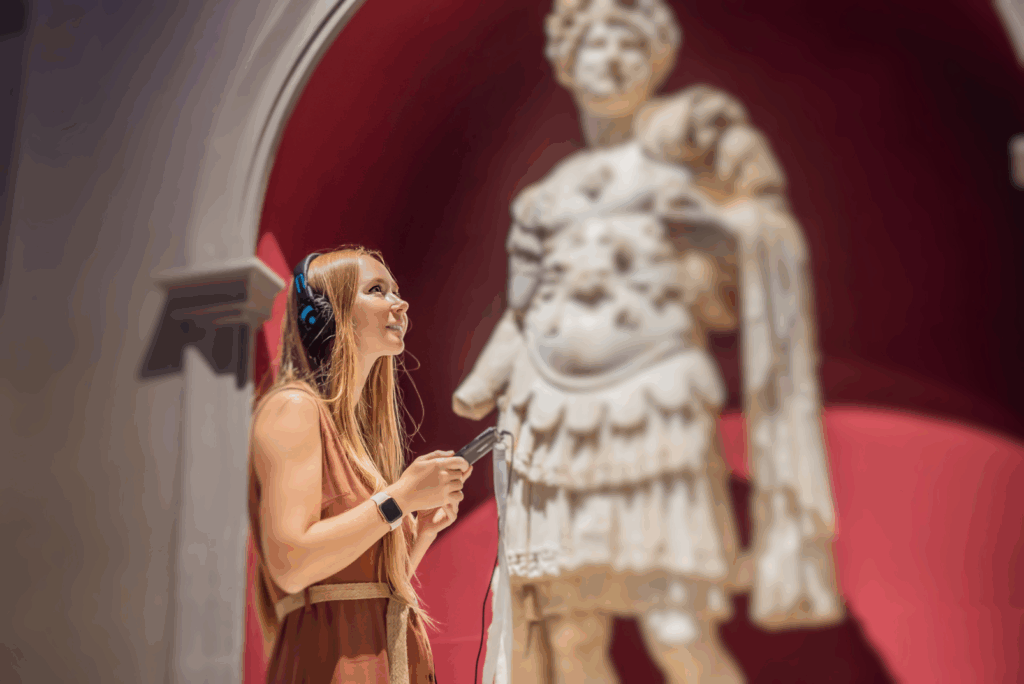
Major museums launched breakthrough projects using AI-powered audio guides that generate personalized tours in real time. Visitors answer three straightforward questions—preferred language, topics of interest, and available time—and the system instantly creates a unique itinerary tailored to their specific profile. Someone passionate about social movement art gets a completely different experience than a parent visiting with young children, even when viewing the exact same exhibition.
This represents something genuinely new in museum practice. For decades, museums created multiple distinct tours: one optimized for children, one for art history scholars, one for casual visitors, one for international tourists. Each required separate curatorial writing, recording sessions, and localization. That multiplied content production costs exponentially. AI changed the fundamental equation. The curator writes the interpretations once, at full depth and quality. The algorithm personalizes the sequence and selection of that content. Infinite variations emerge from finite curatorial investment.
By 2024-2025, this approach has matured significantly. Contemporary platforms now offer AI-driven personalization as standard functionality. The technology works because it respects and amplifies curatorial authority rather than replacing it. The museum’s authoritative voice remains central. The AI organizes and sequences that voice intelligently, serving visitor autonomy.
Immersive Soundscapes
Beyond personalization, museums have embraced sophisticated sound design and immersive audio environments. Historic sites recreate authentic acoustic environments through carefully layered soundscapes. Museums use immersive audio composition to contextualize exhibitions. These aren’t documentary recordings of ambient sound. They’re deliberately designed audio compositions using spatial layering to evoke emotional and historical understanding.
Spatial audio technology—which creates the perceptual illusion of three-dimensional sound where listeners perceive audio cues coming from different directions and distances—has become more accessible and sophisticated. Visitors with standard headphones can experience these effects. The psychological impact is powerful: instead of hearing a narrator explain something, visitors feel transported to a place or time. This represents a fundamental shift from “providing information” to “creating immersive experience.”
Gamification and Interactivity
Beginning around 2018 and accelerating through 2025, museums increasingly incorporated interactive and game-like elements into audio guide design. Museums demonstrated compellingly how narrative choice could engage younger audiences. Visitors made decisions that influenced the story’s outcome, transforming classical antiquities and historical artifacts into adventure narratives with personalized endings based on their choices.
Recent research in embodied cognition validates what museums intuitively understood: interactive elements enhance learning outcomes. Physical movement combined with audio narration and visual observation creates stronger memory formation than passive listening alone. Game-like mechanics increase engagement, particularly with younger visitors. Museums combining rigorous historical narration with professional voice acting, period music, and dramatic soundscapes report consistently high visitor satisfaction and learning retention.
By 2025, interactive audio experiences are no longer experimental territory. They’re becoming expected baseline functionality for forward-thinking cultural institutions competing for visitor attention and satisfaction.
Real-World Examples: Museums Leading the Evolution
Two compelling case studies illustrate how museums have successfully navigated this technological evolution while maintaining curatorial integrity and visitor satisfaction.
The Leif Eiriksson Center: Web App Project
The Leif Eiriksson Center implemented a web app solution that eliminated download friction while delivering sophisticated functionality. Visitors simply scanned a QR code at entry and immediately accessed the audio guide through their browser. This web-based approach allowed for instant content updates without app store delays. The institution could refine interpretations, add seasonal exhibitions, and respond to visitor feedback without requiring users to download updates. The result: higher engagement rates because there was zero barrier between visitor curiosity and experience access.
This implementation validated a crucial principle: technology sophistication isn’t about the platform—it’s about removing friction between visitors and meaningful cultural experiences.
Geothermal Exhibition: Native App Project
The Geothermal Exhibition took a different technical approach, developing a native app that visitors downloaded before arrival or at the museum. This strategy allowed for more advanced features and offline functionality—critical for an exhibition focused on natural phenomena where connectivity might be limited. The native app approach accommodated location-based features, immersive audio, and complex data visualization. Without gaming elements, the experience focused on scientific education and environmental storytelling, using audio guide functionality to contextualize geological concepts and conservation importance.
Both implementations—web app and native app—succeeded by matching technology choice to visitor needs and exhibition requirements rather than imposing a single technical solution universally.
The Current Landscape: Where Museums Stand in January 2026
As of early 2026, the museum audio guide landscape has stabilized around several clear patterns. Understanding these patterns reveals where the sector is moving and what works in contemporary practice.
Market Adoption Status
Mobile-first strategies are now standard for major museums worldwide. Rental device systems have essentially disappeared except in extremely specialized contexts. The question museums ask isn’t whether to go digital—that’s settled—but which platform architecture and technology approach best serves their specific visitors and institutional mission. According to recent industry data, roughly 54% of museums have invested in digital innovation, with 74% having digitized at least part of their collections. Globally, adoption rates are higher in wealthy nations and lower in regions with constrained cultural budgets, but the directional movement is universal.
Technology Preferences
Progressive Web Applications (PWAs) and web-based experiences accessed via QR codes are increasingly preferred over native apps for standard audio guide delivery. The reason is eminently practical: downloading an app specifically for a single museum visit creates friction that reduces adoption. QR code-based web experiences eliminate that friction while delivering sophisticated functionality comparable to native applications. Users experience the benefits of native apps without the download barrier that discourages casual visitors.
Native apps persist when museums want premium, long-form experiences they hope visitors will keep installed and revisit—perhaps a museum the visitor plans to return to multiple times. Hybrid approaches are becoming common: native apps for dedicated cultural enthusiasts who visit frequently, web experiences optimized for one-time visitors or casual engagement.
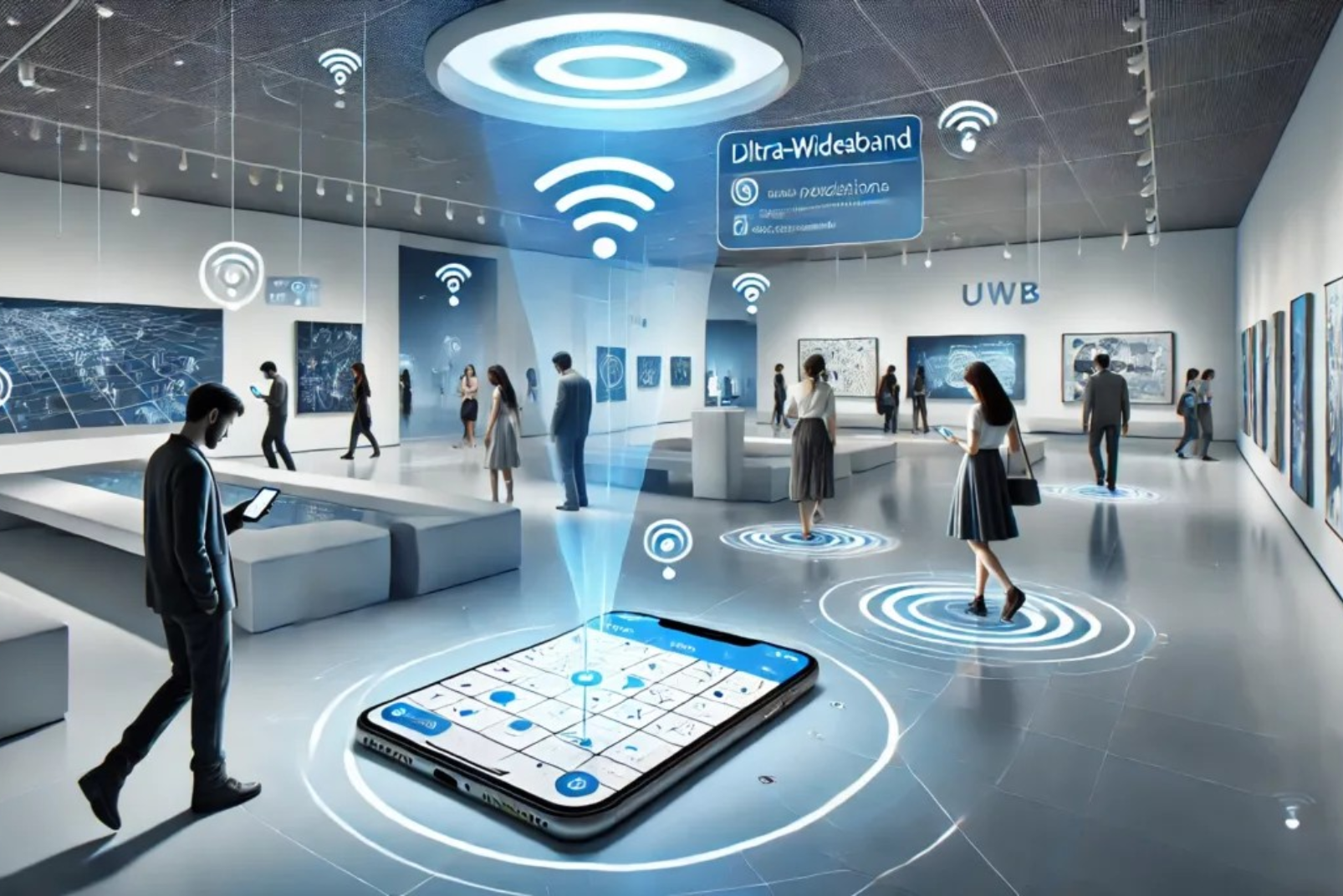
Although web apps are getting better and more capable every year, native apps still provide a more complete experience, with access to technologies like Bluetooth beacons and UWB, advanced gaming features, and seamless multimedia sharing.
The AI Question
Artificial intelligence in museum audio guides is no longer experimental or novel. It’s becoming expected functionality. However, implementation remains thoughtful rather than novelty-driven. Museums understand a critical distinction: AI should organize and personalize curatorial expertise, not generate novel interpretations without human oversight. The global market for AI-generated museum audio guides is projected to reach $2+ billion by 2033, reflecting genuine institutional demand and proven effectiveness.
Forward-thinking institutions implement human-centric AI frameworks emphasizing ethical oversight, visitor-centered design, and transparency about how algorithms function. AI is viewed as a tool that extends curatorial reach and personalizes expertise, not replaces curatorial judgment. This nuanced approach has emerged as the contemporary sector standard.
Accessibility as Standard
Multilingual audio guides in 15+ languages are increasingly standard rather than exceptional. Descriptive audio for visually impaired visitors, real-time transcription for deaf visitors, and age-appropriate content variations are no longer optional extras—they’re core expectations. Only 20% of museums offered content in more than two languages five years ago. Modern technology makes 30+ language support feasible through AI-powered translation and localization. International visitor expectations have shifted accordingly. Accessibility isn’t viewed as feature addition; it’s fundamental to institutional mission.
What Twenty Years Revealed
This two-decade evolution reveals several principles that transcend specific technologies:
- Visitor autonomy matters: Every major technology shift has increased visitor control. Museums learned that giving visitors agency over their experience increases satisfaction and learning outcomes measurably.
- Device independence is critical: Museums that abandoned providing hardware discovered unexpected benefits. Operational simplicity increased. Sanitation concerns disappeared. Visitor diversity expanded. When the pandemic proved the strategic value of device independence, remaining skeptical institutions converted rapidly.
- Content quality trumps interface sophistication: The fanciest interface doesn’t save poor interpretations. Museums learned that when visitors bring their own devices and choose their own engagement level, content becomes paramount. Technology must serve compelling narratives.
- Scale and accessibility expanded together: Mobile technology made sophisticated audio guides accessible to small museums and cultural institutions that could never justify rental device systems. A rural heritage site can now offer multilingual, AI-personalized experiences with modest investment.
- Data transforms understanding: Mobile platforms generate unprecedented insights about visitor behavior. Museums understand which exhibits command sustained attention, which narratives resonate most powerfully. This data informs exhibit design and content improvement.
What’s Next: 2026 and Beyond
Several clear trends are likely to accelerate in coming years:
- Dynamic real-time adaptation: Audio content will adjust in real time to visitor comprehension signals, time constraints, and demonstrated interests rather than following predetermined routes.
- AR audio integration: Spatial audio triggered by location awareness will become more sophisticated. Visitors won’t need to look at screens; audio will guide attention while they observe directly.
- Community-driven narratives: Some museums will experiment with including visitor voices, family stories, and alternative perspectives alongside institutional curation, creating more inclusive interpretation frameworks.
- Natural voice synthesis: AI-generated narration is becoming indistinguishable from human voices. Museums will deploy multiple narrator voices to match exhibition tone rather than recording expensive human narration in dozens of languages.
- Cross-institutional experiences: Digital content won’t be bound by physical walls. Related museums might offer coordinated audio experiences spanning institutions or themed itineraries across a city or region.
Conclusion
Twenty years of audio guide evolution reveals a clear pattern: technology matters most when it serves visitor autonomy, accessibility, and curatorial integrity simultaneously. The shift from rental devices to mobile apps was never really about technology itself. It was about what technology enabled—giving more visitors access to more museums, with more personalized experiences, managed through infrastructure that didn’t burden institutions with operational complexity.
As museums enter 2026, the most important lessons aren’t about specific technologies. They’re about principles: respect visitor agency, invest substantively in content quality, embrace accessibility as core institutional value rather than afterthought, implement AI thoughtfully with human oversight, and remember that technology serves cultural mission, not the reverse.
The next chapter of audio guide evolution will be written by museums that internalize these lessons thoughtfully. Technology will continue advancing exponentially. What matters is how deliberately institutions choose to use it in service of deepening human encounters with culture and history.
Ready to Implement Modern Audio Guide Solutions?
Transform your museum’s visitor experience with contemporary audio guide technology. Locatify’s SmartGuide platform and branded audio guide applications deliver 2025-era functionality combining personalization, accessibility, and ease of deployment.
Learn how Bluetooth beacons enhance museum tours with precise indoor location awareness, and explore our comprehensive guide for creating audio guide web apps.