Balancing Competition and Collaboration: Best Practices for Gamified Learning
The most persistent tension in gamified learning is not between engagement and rigor — it is between competition and collaboration. Both are powerful motivators. Both have documented effects on student performance and participation. And both, when poorly calibrated, can undermine the very outcomes educators are trying to produce. Understanding how to balance these forces is one of the most practical skills an educator can develop when designing gamified experiences, whether in a digital classroom, on a school campus, or in an outdoor field setting.
Why the Competition-Collaboration Balance Matters
Research on gamified learning consistently identifies competition as a double-edged variable. A 2024 meta-analysis published in the British Journal of Educational Technology found that gamification produced moderately positive effects on academic performance overall, but noted that effect sizes varied significantly depending on the social structure of the gamified environment. Highly competitive formats produced stronger short-term engagement spikes but weaker sustained motivation, particularly among students who perceived themselves as performing below their peers.
Collaborative formats, by contrast, produced more durable engagement and stronger gains in communication and problem-solving competencies. The implication is not that competition should be eliminated from gamified learning — it is that competition works best when it is structured carefully and paired with collaborative mechanics that give every student a meaningful role.
The challenge for educators is that most off-the-shelf gamification tools default to competitive structures. Leaderboards, point totals, and speed-based rewards are easy to implement and produce visible engagement. Collaborative mechanics require more deliberate design but produce more equitable and educationally defensible outcomes.
The Psychology Behind Each Mechanic
What Competition Does Well
Competition activates performance motivation — the drive to improve relative to a visible standard. When students can see where they rank against peers, many will work harder to close the gap or maintain their position. This is particularly effective for content that benefits from repetition and speed, such as math fact recall, vocabulary building, or procedural knowledge consolidation.
Competition also introduces stakes. Low-stakes review activities can feel inconsequential to students who do not see the immediate value of engagement. Adding a competitive layer — even a lightweight one — raises the perceived importance of the activity. Research published in Frontiers in Psychology in 2025 confirmed that competitive gamification increased student reporting of perceived challenge and feedback quality, two variables strongly associated with sustained engagement.
Where Competition Creates Problems
The same visibility that motivates high performers can demoralize low performers. When a leaderboard is public and persistent, students who consistently rank at the bottom experience cumulative discouragement. Social Comparison Theory — which describes how individuals calibrate their sense of ability relative to peers — predicts that students who see themselves as significantly behind will reduce effort rather than increase it, because the gap feels insurmountable.
Competition also tends to individualize learning in ways that can work against collaborative skill development. When every student is working to maximize their own score, the incentive to help a peer is removed. In environments where cooperation, communication, and shared problem-solving are core learning objectives, purely competitive gamified structures actively undermine those goals.
What Collaboration Does Well
Collaborative gamified learning structures distribute both responsibility and reward across a team. When a group succeeds or fails together, individual students who might disengage in a competitive format often remain active because their contribution directly affects peers they care about. This social accountability is one of the most robust engagement mechanisms in group-based learning.
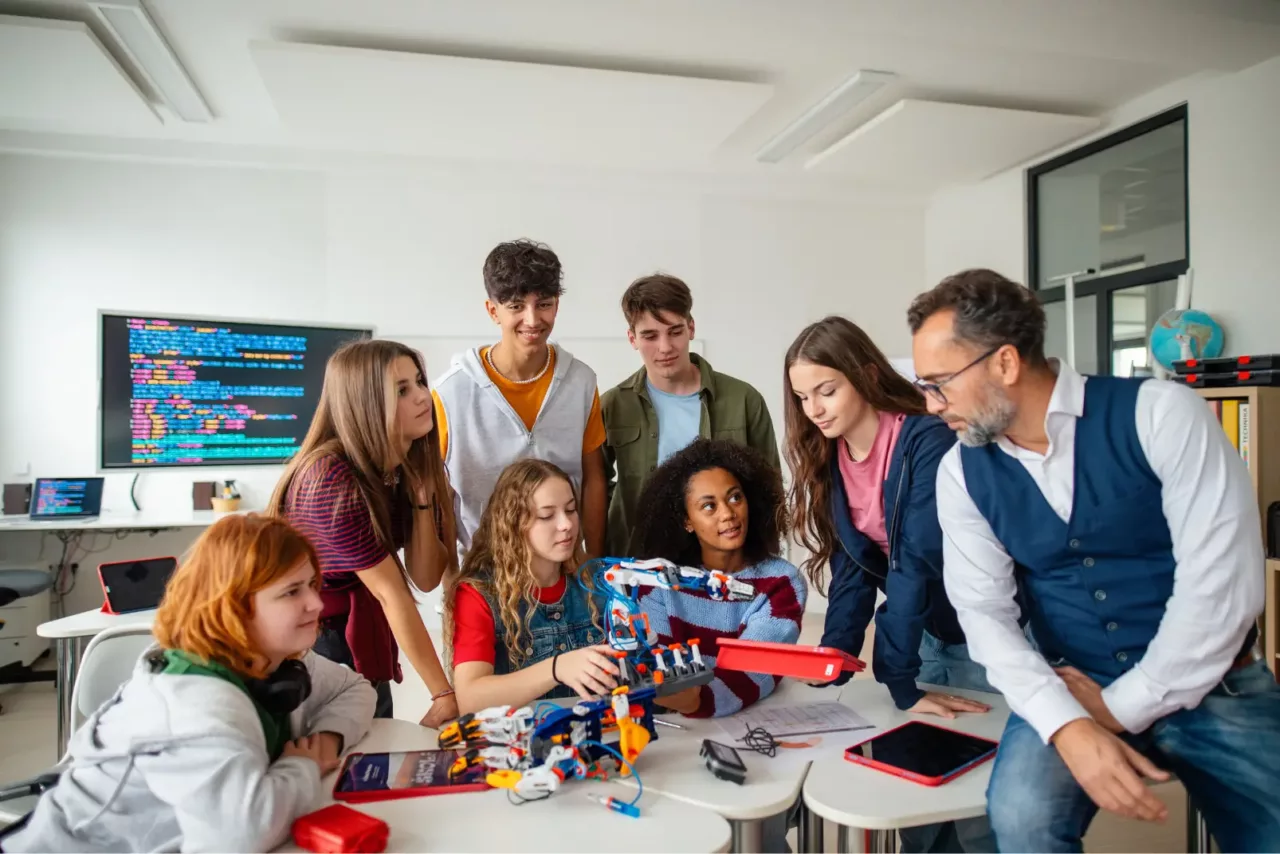
Team-based gamification also mirrors real-world professional environments more accurately than individual competition. Students who develop the ability to coordinate under time pressure, divide tasks strategically, and communicate progress toward a shared goal build competencies that transfer beyond the classroom. Outdoor gamification formats — where teams must physically navigate, observe, and make decisions together — are particularly effective at producing these transferable skills.
Best Practices for Designing Balanced Gamified Learning Experiences
1. Use Team Competition Rather Than Individual Competition
The simplest structural adjustment to a competitive gamified format is shifting from individual to team scoring. When groups compete against each other rather than individuals, the competitive motivation is preserved while the collaborative incentive is added. Students are motivated to help their teammates because doing so directly benefits their collective score. Team structures also distribute the social risk — no single student is publicly identified as the weakest performer.
2. Make Leaderboards Relative, Not Absolute
If individual leaderboards are part of the design, configure them to show personal progress over time rather than static class rankings. A student who sees that they answered 12 more questions correctly this week than last week experiences a motivating signal regardless of where they rank in the class. A student who sees they are ranked 28th out of 30 receives a discouraging signal that may reduce future effort. Many current platforms — including Blooket and Gimkit — offer options to display personal improvement metrics alongside or instead of class rankings.
3. Separate Competitive and Collaborative Phases
Effective gamified lesson design often uses both mechanics in sequence. A competitive review phase — a timed Kahoot! session or Gimkit round — activates engagement and surfaces knowledge gaps. A collaborative problem-solving phase that follows consolidates learning by requiring students to work through those gaps together. The competitive phase provides the motivation; the collaborative phase provides the depth.
4. Design Collaborative Missions for Outdoor and Location-Based Gamification
Outdoor gamification contexts are particularly well-suited to collaborative structures because the physical environment naturally supports division of labor. In a GPS-based team challenge — such as those created with TurfHunt by Locatify — different team members can take responsibility for navigation, documentation, observation, and recording. The spatial and logistical demands of moving through a real environment make collaboration practical rather than merely encouraged. Professors using location-based gamified learning at institutions including the University of Stavanger have noted that outdoor team challenges produce qualitatively different collaborative behaviors than classroom-based alternatives — students negotiate, lead, and defer to each other’s expertise in ways that rarely emerge from a shared screen.
5. Build in Reflection Time
Competitive gamification without reflection produces engagement without learning consolidation. The debrief — even a five-minute structured discussion after a gamified activity — is where much of the actual learning occurs. Students who can articulate why they answered incorrectly, what strategy the winning team used, or what they would do differently next time are processing content at a higher cognitive level than students who simply receive a final score and move on.
6. Match the Mechanic to the Learning Goal
Competition is appropriate when the learning goal is recall speed, procedural fluency, or individual mastery of discrete content. Collaboration is appropriate when the learning goal involves communication, synthesis, problem-solving, or the application of knowledge to novel situations. Many educators make the mistake of using competitive mechanics for learning goals that require collaboration, or vice versa. Auditing the alignment between mechanic and objective is the single most impactful design decision in gamified learning.
A Note on Equity
Any discussion of competition in education must acknowledge the equity dimension. Students from underrepresented groups, students with learning differences, and students who lack confidence in a subject area all experience competitive gamified environments differently than their peers. Educators designing gamified experiences should consider whether the competitive structure they are using creates additional disadvantages for already-marginalized learners — and whether collaborative alternatives might produce equivalent or superior learning outcomes for the full class.
This is not an argument against gamification. It is an argument for designing gamified learning environments with the same intentionality applied to any other instructional choice: with awareness of who benefits, who might be excluded, and how the design can be adjusted to serve all learners more effectively.
Related Reading
→ Gamification in Education: From Classrooms to Outdoor Learning — locatify.com/blog/digital-gamification-platforms-k12
→ Location-Based Learning: Using GPS Technology for Outdoor Education — https://locatify.com/gamification-in-education-from-classrooms-to-outdoor-learning/