A lender changes a credit line after the narrator has recorded it. A work moves from the entrance to the last room. The labels have gone to print. For a temporary exhibition audio guide, the opening date turns small editorial decisions into production dependencies. The easiest guide to launch is one in which a change to a single object can be traced through its script, recording, transcript, label, and visitor link.
Work backward from the first public visit. Decide which stops must be ready to tell a coherent story, give every stop a stable identifier, and test the exact signs and audio that visitors will use. Give the closing date an owner at the same time. A visitor scanning a saved link after the show ends deserves an intelligible answer, too.
Define an opening-day edition you can actually deliver
Take the object list to the exhibition curator. Ask which objects establish the main argument, which add nuance, and which are still awaiting confirmation. Build the opening edition around confirmed works that carry the argument. If the exhibition turns on a conversation between a print and its preparatory drawing, protect both recordings. A longer biography can wait if the visitor already has enough context to understand the pairing.
Choose a time budget by walking the exhibition. Include the time to locate each object, look at it, and move on. As a planning example, six recordings of 90 seconds total nine minutes of audio. If your test walk leaves ten minutes for the whole visit, the proposed edition leaves a single minute for every transition and observation combined. Shorten the playlist or offer a clearly labeled selection before recording all six tracks.
Build a stop register that survives a gallery change
| Field | Example entry | Who uses it |
|---|---|---|
| Stable stop ID | EX-04 | Producer aligns every asset even if a work moves rooms. |
| Public identifier | Stop 4, “The Working Drawing” | Visitor services matches signs to the tour index. |
| Object and approved credit | Museum object ID plus lender-approved wording | Curator checks identity and attribution. |
| Script, recording, transcript | English revision 3 for all three assets | Editor catches a transcript or recording from a previous cut. |
| Permission and end date | Approved channels and dates recorded in project file | Producer knows what can remain online after closing. |
| Last gallery check | Initials, date, actual room, outstanding correction | Exhibition manager can make an opening decision. |
Keep spoken directions separate from the interpretive narration wherever possible. “Find the study titled River Crossing” can survive a rehang. “Turn left at the red wall” may require fresh audio after a modest floor-plan change. If a direction is essential, make it a separately editable element and include it in the final walk-through.
Write scripts that give the visitor time to look
Read the opening sentence while facing the work. A good first line gives a visitor somewhere to rest their eyes. For an imagined exhibition on printmaking, try “Look at the dark edge of the sleeve. Its width changes where two lines meet.” Follow the observation with what the curator can support about the method or artistic decision. Read the script aloud again and leave a real pause where the listener needs to look.
Ask the editor to flag names, dates, terms in other languages, and any passage whose meaning depends on an image. Give the narrator a pronunciation reference approved by the appropriate contributor. For each language edition, review directions, object titles, and credits together. A translated title can be accurate and still be impossible to match to a label that displays only the original title. Include the label wording where a visitor needs it. Locatify plans to offer AI credits in its CMS for text-to-speech narration, transcription, and translation. If you plan to use these tools, confirm availability before setting your production schedule.
Approve the script before booking final narration. After editing, have a second person listen while reading the transcript. Check names, edited sentences, speaker changes, and meaningful non-speech sounds. Give visitors an easy way to find the text from the listening screen. W3C’s transcript guidance explains which details make a transcript useful.
Decide how visitors will open the guide
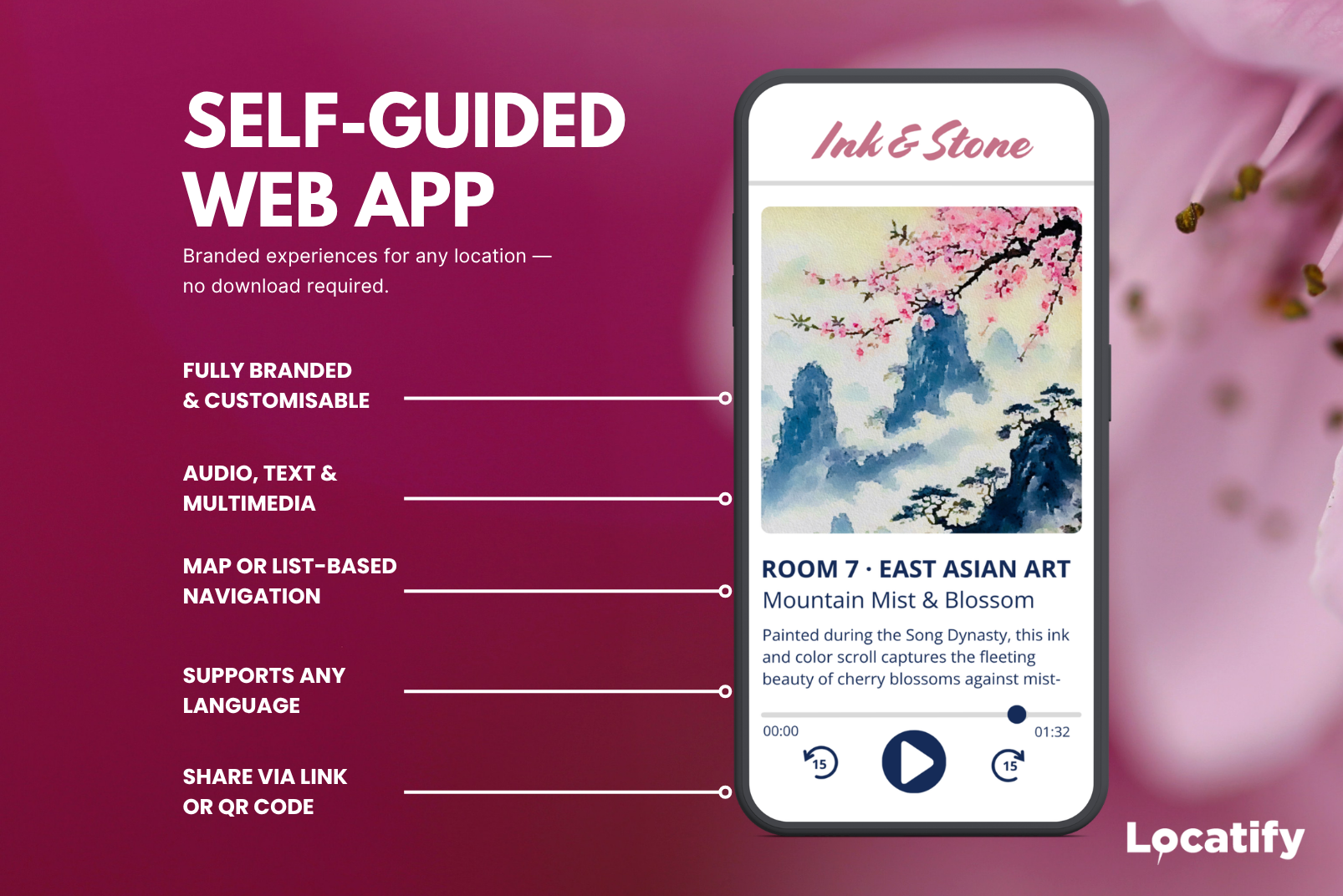
For a short-run show, a browser guide can keep the entrance instruction simple. Locatify’s self-guided web app opens from a QR code or link and can present audio, images, video, and text at points of interest. Test the visitor connection in the galleries before selecting this route. For background on other delivery formats, see the history of museum audio guides. For the specific visitor workflow, see Locatify’s self-guided web tours.
Give the printed sign a short instruction, a readable alternative address, and the exhibition name. Check the proof at its intended size, from the place a visitor will stand. Open the code on a phone that has never accessed the project. A staff device logged into a content editor cannot establish that the public link works. If the guide supports several languages, follow each advertised path through to a playable first stop.
Rehearse three failures before opening
A loan arrives late. Temporarily remove its stop from the visitor route on a test copy. Follow all references from neighboring tracks, the introduction, printed material, and each language index. If removing it breaks the story, prepare a museum-approved substitute stop or revise the opening edition.
The entrance works and the second room does not. Walk the trail using the visitor network. At the weak spot, open a stop that the phone has never loaded. Check playback and transcript access. A track replaying from the previous test can hide a delivery problem. Give front-of-house staff a working alternative, such as the approved printed text, while the issue is resolved.
The guide points to the wrong artwork. Hand the final phone screen and printed label to a colleague who has never attended a production meeting. Ask them to identify the object and show the detail mentioned in the track. Correct the first point of ambiguity, whether it is the thumbnail, number, title, or physical placement. Repeat the test in the room after the fix.
Hand over the guide to the people who will run it
At opening, give visitor services a one-page reference with the starting link, instructions for a person without headphones or a smartphone, and one contact who can authorize a correction. Ask staff to log the stop ID and exact wording of a visitor problem. “French introduction opens the English recording” is actionable. “The app is confusing” needs a follow-up observation before anyone can fix it.
Before closing, review which recordings, images, and translations may stay available and for how long. Decide where the entry link should lead once the physical works leave. A short exhibition archive with the opening and closing dates can acknowledge the original experience while directing readers to material the museum can continue sharing. Remove or replace signs, check bookmarked links, and preserve the approved production files for the next team.
A useful final acceptance test takes place at the door. Can a visitor who missed the introductory sign find the right work, hear or read its story, and continue through the exhibition? Can a member of staff correct that experience tomorrow if the work moves? When both answers are yes, the museum has a guide it can operate for the entire run.